Reading the New York Times report alone, one would conclude that the Chinese Communist Party (CCP) uses its consulate in New York City to guide Chinese associations and influence American local politics. But this only shows the surface phenomenon. What the article did not reveal is the deeper chain of command that connects all these groups back to the CCP’s United Front system.
1. The CCP’s Overall Strategy: United Front Work
🔹United Front Work Department (UFWD): A central organ of the CCP directly under the Central Committee, tasked with “winning hearts and minds” by co-opting non-Party individuals and groups both inside and outside China.
🔹Strategic Goal: To incorporate overseas Chinese, businesspeople, students, and associations into networks that can be mobilized for pro-CCP political objectives.
2. Overseas Execution Tools
🔹Hometown associations, clan groups, alumni associations: Outwardly cultural or communal, in practice they function as the “nerve endings” of the CCP’s United Front network.
🔹Business associations and cultural nonprofits: Often registered as U.S. charities or 501(c)(3) organizations under the guise of “charity” or “cultural exchange,” while actually carrying out pro-CCP political missions.
🔹CCP-linked groups such as the China Overseas Friendship Association or pro-unification organizations: These entities maintain branches abroad and directly coordinate with Chinese embassies and consulates.
Thus, these “independent associations” are in reality connected through a clear line of authority: UFWD → Overseas Chinese Affairs Office (absorbed into UFWD) → diplomatic system (embassies and consulates).
3. The Role of the Consulate
🔹Command and oversight: The PRC Consulate in New York convenes association leaders, organizes “hometown days” or “national day celebrations,” and requires explicit shows of loyalty to the CCP.
🔹Political mobilization: When U.S. politicians address issues like Taiwan, Tibet, or human rights, the consulate directs these groups to stage protests, lobby, or flood officials with letters.
🔹Personal leverage: Many association leaders have family or business interests in China. The CCP uses the safety of relatives and business access as leverage to ensure compliance.
4. Penetration of U.S. Politics
🔹Election influence:
🔹Mobilizing association members to endorse or donate to pro-CCP candidates.
🔹Pressuring or intimidating those who dare to support Taiwan or criticize the CCP.
🔹Long-term strategy: Today’s city council member or state legislator could be tomorrow’s congressman—or even a presidential candidate.
🔹Legal camouflage: By operating as “nonprofit organizations,” these groups conceal their political activities and bypass U.S. election laws.
5. The Hidden Control Chain
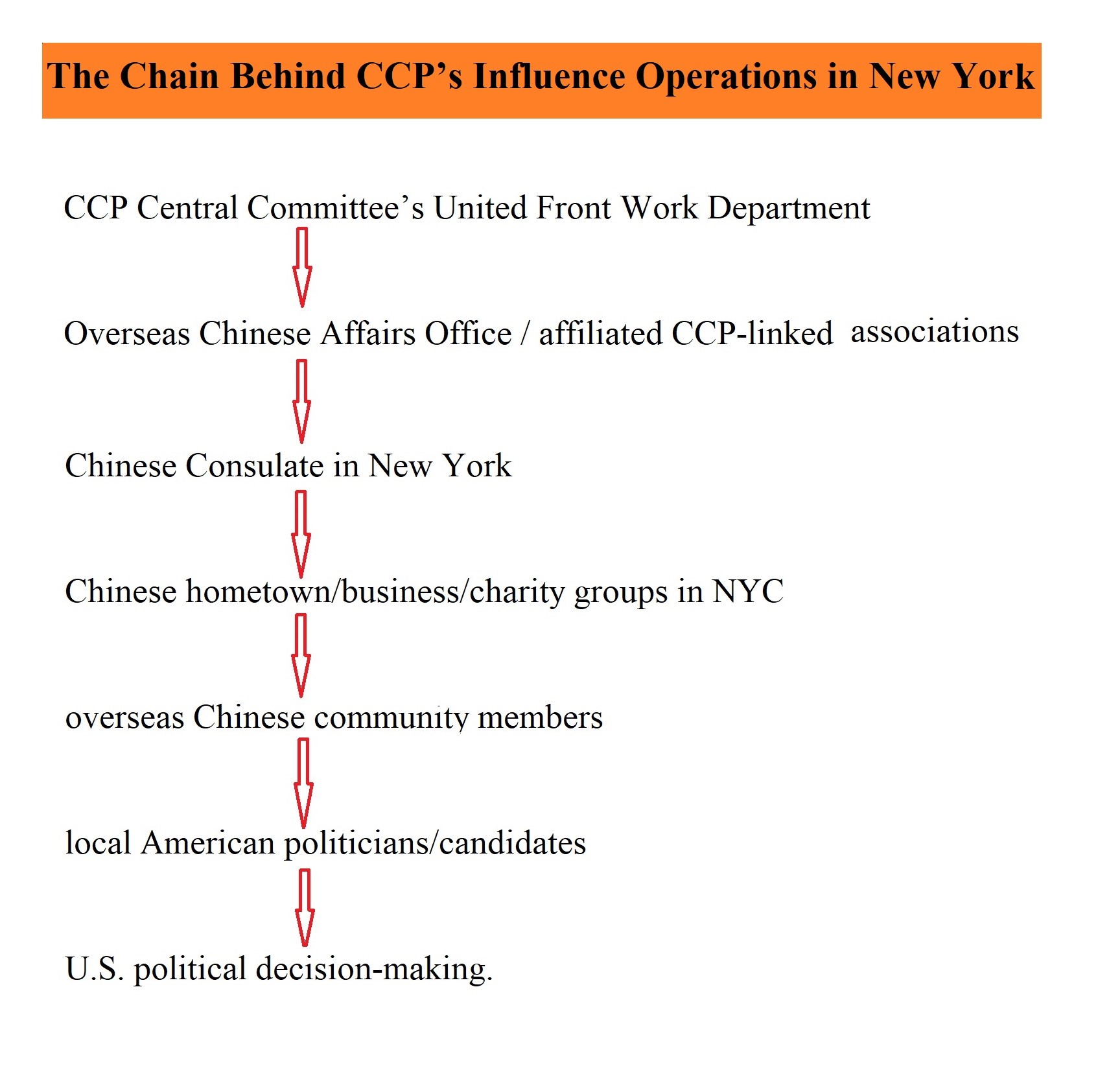
The real structure looks like this:
CCP Central Committee’s United Front Work Department ➡️ Overseas Chinese Affairs Office / affiliated CCP-linked associations ➡️ Chinese Consulate in New York ➡️ Chinese hometown/business/charity groups in NYC ➡️ overseas Chinese community members ➡️ local American politicians/candidates ➡️ U.S. political decision-making.
What the New York Times Didn’t Cover
The Times exposed factual activities (groups endorsing candidates, consulate officials leading oaths), but it didn’t spell out a few key points:
🔹These groups are not isolated actors but part of the CCP’s global United Front network.
🔹The consulate is not acting independently but as the frontline extension of that system.
🔹This is not a random occurrence but a long-term CCP strategy, rooted in decades of “overseas Chinese affairs” work.
❗️Bottom line: What appears to be “local associations” endorsing candidates is in fact a systematic infiltration project directed by the CCP’s United Front system, executed by consulates, and carried out by local pro-CCP proxies in the Chinese community.
 The Light in the Shadows
Leave a comment