Only decoupling from the CCP can end the threat.
The Chinese Communist Party (CCP) is increasingly using America’s legal lobbying system and political donation infrastructure to shape U.S. policy and political dynamics. Based entirely on open-source data, this article exposes a traceable chain of influence—from CCP-blacklisted companies, to the U.S. law firms that represent them, to the PACs those firms operate, and finally to the U.S. politicians who receive their support.
1. CCP-Blacklisted Chinese Corporations
The U.S. Department of Defense and the Department of Commerce have listed numerous Chinese companies as national security threats due to their affiliations with the CCP’s military and surveillance apparatus. One such company is Hesai Group, a lidar technology manufacturer heavily involved in autonomous vehicle systems and data collection, which was added to the U.S. trade blacklist in 2024.
Being blacklisted should have removed Hesai from meaningful access to the U.S. market. Instead, the company took a different route—by hiring powerful American legal actors.
2. U.S. Law Firms Representing CCP Clients
Despite its blacklisted status, Hesai was able to retain the services of Brownstein Hyatt Farber Schreck and Akin Gump Strauss Hauer & Feld LLP, two of the most influential law firms in Washington, D.C. These are fully credentialed U.S. law firms—not Chinese-owned fronts—yet they have openly represented companies already deemed a threat by the U.S. government.
Why would top-tier U.S. law firms represent companies formally identified as security risks?
A likely explanation is that the CCP exerts pressure through a combination of financial incentives, long-term business ties, and potentially even compromising information. What appears to be routine client service may in fact be part of a coordinated strategy of infiltration.
3. PACs as the Financial Conduits
This strategy would not be complete without the role of Political Action Committees (PACs).
PACs—formally known as Political Action Committees—are organizations registered with the Federal Election Commission (FEC). They legally collect and distribute campaign contributions to support or oppose candidates, parties, or legislation.
Many U.S. law firms operate their own PACs to support politicians they are lobbying or wish to build influence with. While this is legal, it creates a murky dynamic where foreign-linked interests are funneled through American institutions into the hands of U.S. lawmakers.
In the case of CCP-linked companies, here is how the pattern plays out:
•BHFS PAC, affiliated with Brownstein Hyatt Farber Schreck, contributed hundreds of thousands of dollars to the Democratic Senatorial Campaign Committee (DSCC), the Democratic Congressional Campaign Committee (DCCC), and high-ranking politicians like Senators Jacky Rosen and Maria Cantwell.
•Akin Gump PAC similarly made donations to both parties, including large sums to the campaign of Kamala Harris, former Vice President of the United States.
•Sidley Austin LLP, which has previously provided legal services to Huawei, Hikvision, and DJI—all firms with ties to the Chinese military-industrial complex—also operates a PAC. This PAC contributed to the Democratic National Committee (DNC) and individual campaigns such as that of Congressman Frank Pallone.
All of this is legal—but legality does not equal innocence.
4. The Chain of Influence
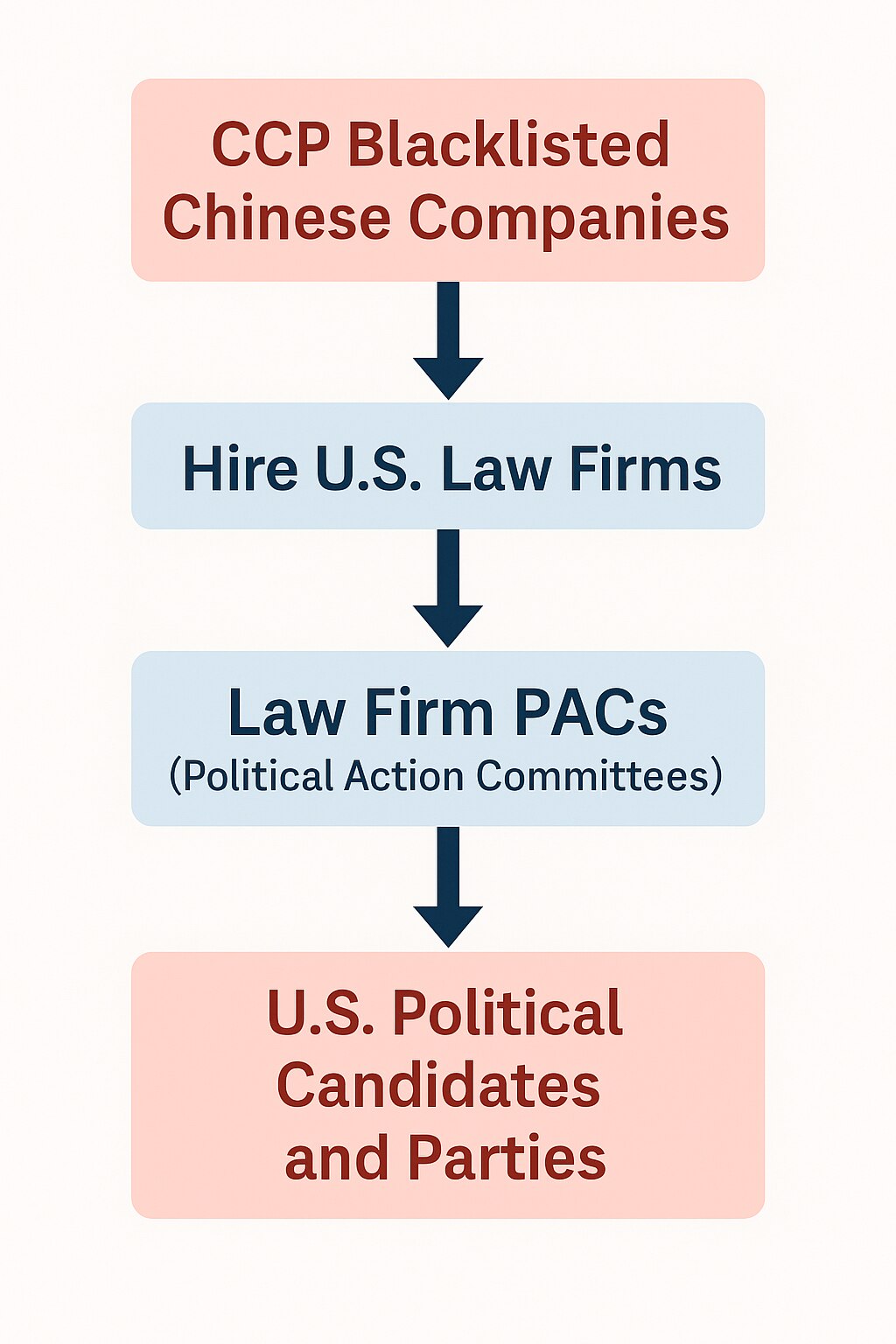
The chain can be clearly mapped:
CCP-Blacklisted Companies → U.S. Law Firms → PAC Donations → Politicians → Policy Influence
Lawmakers receive both lobbying pressure and financial support from firms that are representing CCP-affiliated clients. In return, many of these politicians respond to China-related issues with ambiguity, delay, or softness—and increasingly, some go further by opposing positions they ought to defend, betraying their sworn duty to uphold national security and American interests.
This is no longer isolated corruption. It’s systemic infiltration dressed in legal garments.
5. The Structural Vulnerability
The most dangerous threat is not what’s illegal—it’s what’s legal but strategically exploited.
The CCP has identified and capitalized on a structural vulnerability in the American political system: by targeting law firms, using them as lobbying intermediaries, and letting PACs legally distribute donations, it can shape American policy from within—without ever needing to break the law.
This vulnerability is real, active, and already embedded in the nation’s political bloodstream.
6. The Only Answer: Decoupling
The Chinese Communist Party doesn’t need to rig voting machines or deploy hackers. It only needs to buy law firms. Through them, it buys political donations, molds legal language, and slowly bends the direction of a nation.
If America wants to preserve its sovereignty, it must decisively decouple from the CCP—not just in trade or technology, but in law, funding, and political influence.
If you believe the American people deserve to know this, share this article.
Choose to see when others keep their eyes shut.
Find the invisible hand behind the law—the CCP’s malicious hand—and have the courage to cut it off.
 The Light in the Shadows
Leave a comment