Understanding the true boundary of the First Amendment—where dissent is protected, but complicity with crime is not.
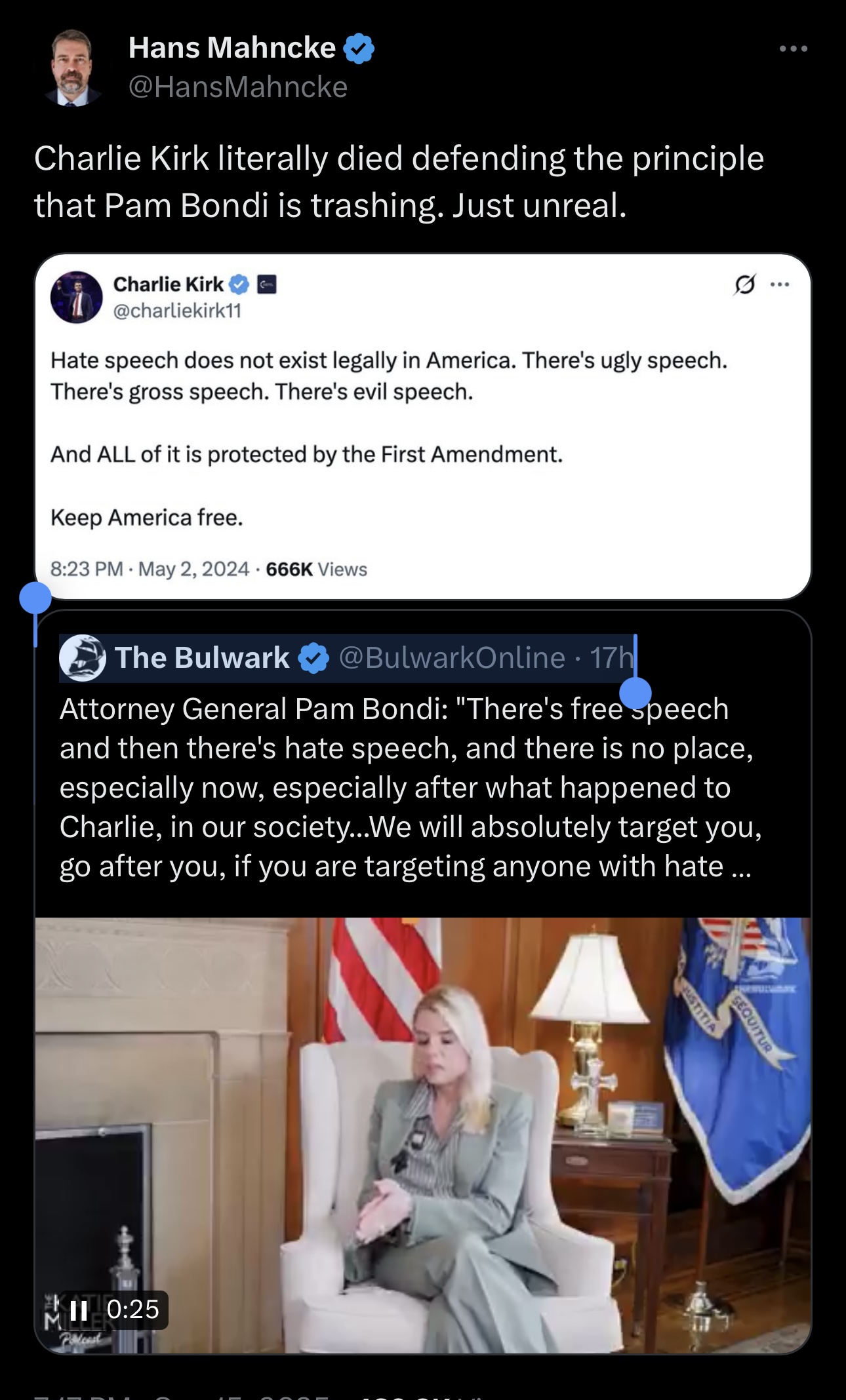
Charlie Kirk’s words still echo today, even after his assassination. What he said was not merely a personal opinion—it was a living reflection of the Constitution itself. The statement from Charlie that you see in the image—“There is no such thing as hate speech legally. Ugly speech, vile speech, evil speech—all of it is protected by the First Amendment”—must be understood in its proper context.
This is not a simple matter—it touches the very soul of the Constitution.
Charlie Kirk’s Position and Context
Charlie Kirk never spoke words of hate. Those who knew him or listened to him recognize that he spoke with conviction and courage, but not with hatred toward others. What he defended was not his own right to be hateful, but the principlethat in a peaceful society, every citizen has the right to express their opinion—even if that opinion is offensive, harsh, or spoken with anger.
In such a peaceful setting, as long as speech does not involve threats, intimidation, or incitement to violence, the Constitution protects it. That is the core of what Charlie was saying, and it reflects the true meaning of the First Amendment.
The Constitutional Boundary of Free Speech
The First Amendment guarantees the right to express any opinion—whether agreeable, offensive, or hostile.
The only clear boundary is this: speech must not involve threats, intimidation, or incitement to violence.
Therefore, as long as words are expressed in a peaceful context, however sharp or extreme they may be, they fall within the realm of free speech. This is the principle Charlie Kirk lived by and defended.
When Tragedy Changes the Nature of Speech
Here is the crucial distinction: the nature of speech changes when a crime has been committed.
When Charlie was assassinated, and people publicly rejoiced over his death or spoke with hatred toward him in that moment, those words were no longer mere “opinions.” They became, in effect, a form of complicity with the murderer—normalizing the crime, even justifying it.
In such a context, words cross the line from expression into moral participation in evil. More than that, such words also strike at the very heart of the Constitution: by celebrating an act of violence and siding with the criminal, they take the form of intimidation, threat, or incitement to further violence. In this sense, they have already stepped outside the realm of protected speech.
This distinction is essential: Charlie defended free speech in peace, not speech that celebrates crime.
A Response to the Attorney General’s Remarks
In her statement, the Attorney General Pam Bondi divided speech into free speech and hate speech, claiming broadly that “hate speech has no place in society.”
This framing is inconsistent with constitutional principles. In a peaceful setting, the Constitution grants every individual the right to speak—whether words are kind or hostile. As long as speech does not cross into threats, intimidation, or incitement to violence, it must be protected. Creating a vague category of “hate speech” risks government overreach and abuse.
That said, she did emphasize the particular case of Charlie Kirk’s murder, stressing that in such a context, so-called “free speech” cannot be used to cheer for or shield criminals. In this sense, she was drawing a line between “crime” and “expression.” While her overall framing is problematic, this point is at least better than ignoring the issue altogether, and it deserves some credit.
Conclusion
The principle Charlie Kirk stood for was ensuring that all voices could be heard in the public square—even those filled with bias or hostility. What he defended was never the “freedom” to celebrate crime, but the freedom to preserve open debate in a peaceful society without silencing dissent through political labels like “hate speech.”
True free speech protects expression in peace, while drawing a firm boundary against complicity with crime. And the tragic reality of Charlie’s assassination makes this distinction all the more urgent for us to understand today.
Understanding the true boundary of the First Amendment—where dissent is protected, but complicity with crime is not.
Charlie Kirk’s words still echo today, even after his assassination. What he said was not merely a personal opinion—it was a living reflection of the Constitution itself. The statement from Charlie that you see in the image—“There is no such thing as hate speech legally. Ugly speech, vile speech, evil speech—all of it is protected by the First Amendment”—must be understood in its proper context.
This is not a simple matter—it touches the very soul of the Constitution.
Charlie Kirk’s Position and Context
Charlie Kirk never spoke words of hate. Those who knew him or listened to him recognize that he spoke with conviction and courage, but not with hatred toward others. What he defended was not his own right to be hateful, but the principlethat in a peaceful society, every citizen has the right to express their opinion—even if that opinion is offensive, harsh, or spoken with anger.
In such a peaceful setting, as long as speech does not involve threats, intimidation, or incitement to violence, the Constitution protects it. That is the core of what Charlie was saying, and it reflects the true meaning of the First Amendment.
The Constitutional Boundary of Free Speech
The First Amendment guarantees the right to express any opinion—whether agreeable, offensive, or hostile. The only clear boundary is this: speech must not involve threats, intimidation, or incitement to violence.
Therefore, as long as words are expressed in a peaceful context, however sharp or extreme they may be, they fall within the realm of free speech. This is the principle Charlie Kirk lived by and defended.
When Tragedy Changes the Nature of Speech
Here is the crucial distinction: the nature of speech changes when a crime has been committed.
When Charlie was assassinated, and people publicly rejoiced over his death or spoke with hatred toward him in that moment, those words were no longer mere “opinions.” They became, in effect, a form of complicity with the murderer—normalizing the crime, even justifying it.
In such a context, words cross the line from expression into moral participation in evil. More than that, such words also strike at the very heart of the Constitution: by celebrating an act of violence and siding with the criminal, they take the form of intimidation, threat, or incitement to further violence. In this sense, they have already stepped outside the realm of protected speech.
This distinction is essential: Charlie defended free speech in peace, not speech that celebrates crime.
A Response to the Attorney General’s Remarks
In her statement, the Attorney General divided speech into free speech and hate speech, claiming broadly that “hate speech has no place in society.”
This framing is inconsistent with constitutional principles. In a peaceful setting, the Constitution grants every individual the right to speak—whether words are kind or hostile. As long as speech does not cross into threats, intimidation, or incitement to violence, it must be protected. Creating a vague category of “hate speech” risks government overreach and abuse.
That said, she did emphasize the particular case of Charlie Kirk’s murder, stressing that in such a context, so-called “free speech” cannot be used to cheer for or shield criminals. In this sense, she was drawing a line between “crime” and “expression.” While her overall framing is problematic, this point is at least better than ignoring the issue altogether, and it deserves some credit.
Conclusion
The principle Charlie Kirk stood for was ensuring that all voices could be heard in the public square—even those filled with bias or hostility. What he defended was never the “freedom” to celebrate crime, but the freedom to preserve open debate in a peaceful society without silencing dissent through political labels like “hate speech.”
True free speech protects expression in peace, while drawing a firm boundary against complicity with crime. And the tragic reality of Charlie’s assassination makes this distinction all the more urgent for us to understand today.
 The Light in the Shadows
Leave a comment