1. What Unrestricted Warfare Really Is
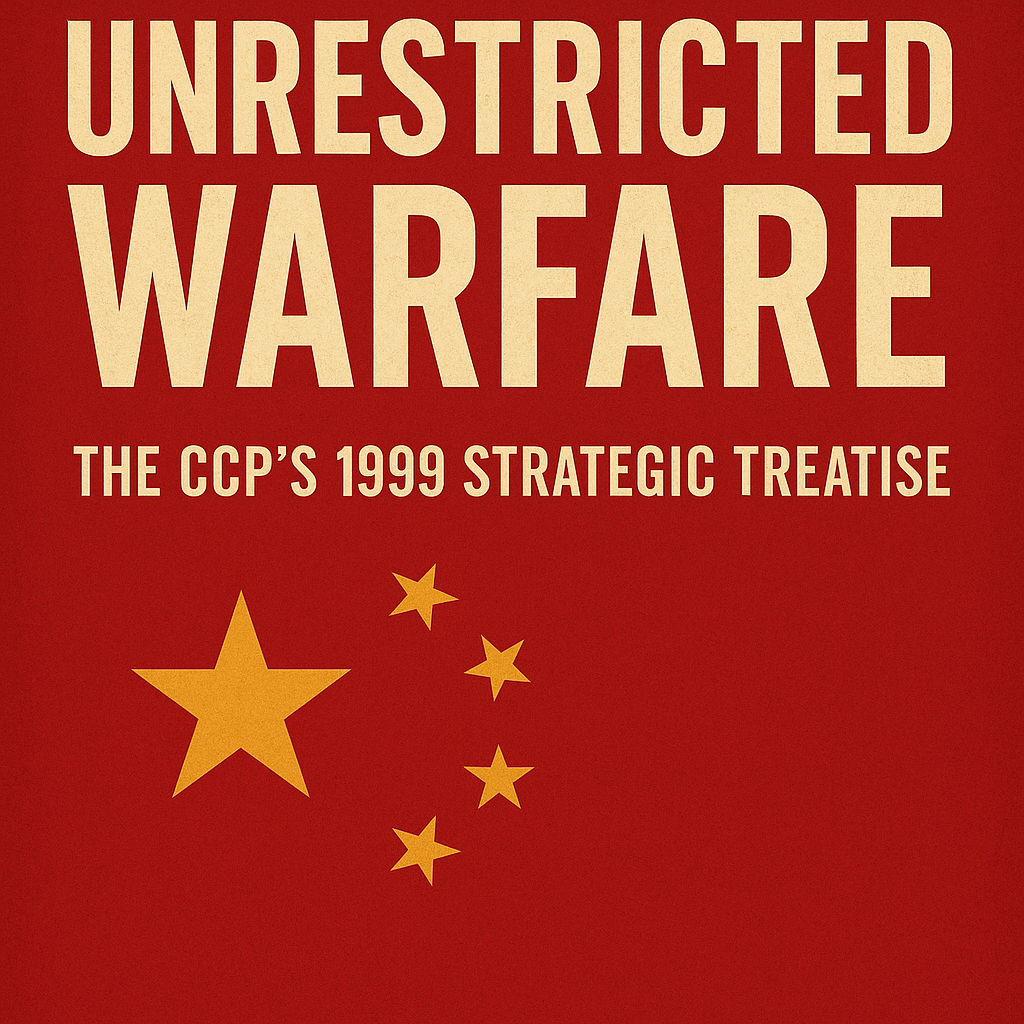
In 1999, two officers of the People’s Liberation Army of the CCP published a work titled Unrestricted Warfare. It is not propaganda, not academic commentary, and not a policy memo.
It is a strategic treatise—a blueprint for how an authoritarian regime can weaken the United States without engaging in conventional military conflict.
The book opens with a radical premise:
War is no longer confined to the battlefield.
Any domain—economic, financial, technological, cultural, psychological—can be weaponized.
1.1 Redefining the Boundaries of War
According to the authors:
Anything can be a weapon.
Anyone can be a combatant.
Any environment can be a battlefield.
This dissolves the traditional distinction between “war” and “peace.”
It legitimizes the use of indirect, unorthodox, and multi-domain tools to undermine a rival nation.
1.2 The 24 Forms of Modern Warfare
The treatise lists dozens of non-military warforms, including:
- financial warfare
- information warfare
- psychological warfare
- legal warfare
- cultural warfare
- technology infiltration
- cyber warfare
- economic coercion
- capital warfare
- criminal and drug networks
- population warfare
- diplomatic pressure
- narrative and media warfare
The key idea is simple:
Use multiple warforms simultaneously to overwhelm an open society from within.
Section Summary: How This Relates to Today
The authors of the Book did not explicitly list every domain—especially political warfare or electoral interference—but their logic fully includes them. Information warfare influences political attitudes; psychological warfare shapes elections; legal warfare paralyzes institutions; population warfare alters long-term political outcomes.
The book’s categories overlap naturally, and in today’s world these combined tactics are exactly what the United States is experiencing.
2. How the Treatise’s Objectives Have Already Become Reality
Unrestricted Warfare is shocking not because it predicted the future, but because the future now looks exactly like the book described.
2.1 Technology Infiltration and Dependency
Critical technologies, electronics, rare-earth elements, and data pipelines have become structurally dependent on the PRC state system.
2.2 Financial Influence and Capital Leverage
Corporations modify operations to satisfy the CCP regime’s demands. Global markets react to signals coming from the CCP.
Investment dependencies shape political calculations.
2.3 Academic and Institutional Penetration
Universities rely on students, funding, and partnerships tied to the CCP’s China, creating self-censorship and strategic silence.
2.4 Information and Narrative Warfare
Digital platforms shape global discourse.
Content favorable to the CCP narrative is amplified; content critical of the regime is pressured or sidelined.
2.5 Cultural and Psychological Warfare
Media ecosystems reshape values, identity, and national confidence in ways aligned with the CCP’s political goals.
2.6 Drug and Criminal Warfare
The fentanyl supply chain—originating from networks operating inside the PRC system—has devastated American communities.
2.7 Population Warfare
Migration pressure and trafficking networks have created demographic, political, and social instability, consistent with tactics outlined in the treatise.
2.8 Supply Chain Control
Pharmaceuticals, electronics, and critical materials rely heavily on the PRC-controlled supply chain, giving the regime significant leverage.
2.9 Cyber Warfare
Attacks on infrastructure, data systems, government institutions, and private networks have become constant and increasingly sophisticated.
Section Summary: The Strategic Convergence
Each of these is one strand of a larger system.
Together, they represent the full-spectrum, cross-domain pressure outlined in Unrestricted Warfare. The treatise did not mention every modern term—like “election interference” or “institutional capture”—but its framework fully encompasses them.
In reality, the United States is not facing separate challenges; it is facing the convergence described in a 1999 CCP strategic document.
3. Why the CCP Felt Safe Enough to Publish This Treatise
This is the most important question:
Why would the CCP regime openly publish a document revealing its real strategy?
Why expose its methods?
Why not hide them?
The answer lies in the global environment of the late 1990s.
3.1 In 1999, the CCP Believed It Was Completely Safe
Several forces gave the regime overwhelming confidence:
(1) Powerful factions within the United States favored deep cooperation with the PRC
Wall Street, multinational corporations, universities, and tech sectors all benefited from Beijing’s rise under the CCP.
(2) The global economy relied increasingly on the PRC system
Manufacturing, exports, and supply chains had begun shifting to the CCP’s China.
(3) Western media and academia avoided confronting the CCP
Criticism carried political and financial costs.
(4) U.S. intelligence agencies focused elsewhere
The Middle East was seen as the primary threat, not the PRC regime.
(5) The CCP’s internal confidence was at its peak
The authors of the Book believed the West neither understood nor would respond to the CCP’s strategy.
Publishing the treatise felt not dangerous—but triumphant.
3.2 Only After Exposure Did Regret Begin
When Miles Guo and some other whistleblowers brought the book to Western attention years later, and as the world began to observe its strategies becoming reality, the CCP realized it had revealed too much.
Copies disappeared.
Public discussion faded.
The treatise quietly retreated from view.
3.3 Implementation Required Both Domestic Machinery and International Enablers
To turn Unrestricted Warfare into reality, the CCP relied on two pillars of power.
The CCP controls every internal lever of force:
Domestic Machinery
its propaganda apparatus, security organs, cyber infrastructure, intelligence networks, state-owned enterprises, and the united front system.
These tools require no further explanation; an authoritarian regime wields them without restraint.
International Enablers
But the second pillar is even more important:
the global forces that cooperated with the CCP—knowingly or unknowingly.
This includes multinational corporations, financial institutions, supply-chain dependencies, academic partnerships, diplomatic leverage, and various external actors who aligned themselves with the CCP’s interests.
Yet the most critical enabler was not outside pressure, but the CCP’s most enduring resource:
the greed within the United States and other free nations—the very societies the CCP views as its rivals.
It was this willingness to profit from the CCP’s rise, to overlook its abuses, and to sacrifice long-term security for short-term gain that gave Unrestricted Warfare the international oxygen it needed.
This is not conspiracy; it is structural alignment. It is a fact we have already experienced.
Section Summary: Why This Matters Now
The CCP’s confidence explains why the treatise was written so openly and why its strategies have unfolded so effectively.
Understanding this context allows readers to see Unrestricted Warfare not as abstract theory, but as the operating logic behind today’s geopolitical reality.
Conclusion
Unrestricted Warfare is not a relic of 1999.
It is the operating system of the CCP regime—and the framework behind the crisis America faces today.
Every domain the authors of the Book wrote about has already become a battlefield:
our borders, our media, our supply chains, our universities, our financial markets, our digital platforms, and even our political institutions.
What the authors described as theoretical possibilities have unfolded in real time, year after year, until the United States now stands at the edge of a cliff.
This is not the result of random global trends or internal dysfunction. It is the predictable outcome of a decades-long strategy executed by a regime that never hid its intentions—because it never believed America would notice.
To understand Unrestricted Warfare is not to study the past. It is to finally recognize the present. It is to see that America is already inside the very conflict the CCP described:
a war without gunfire, without fronts, without declarations—yet a war capable of hollowing a nation from within.
Recognizing this truth is not fearmongering.
It is the first act of national self-defense.
America cannot recover, cannot respond, and cannot survive this moment until it understands the strategy that has brought us here.
And that strategy was written, openly and triumphantly, in a book published by the CCP in 1999.
 The Light in the Shadows
Leave a comment