This article analyzes a structural national security failure revealed by recent congressional investigations: how U.S. taxpayer-funded research was lawfully and systematically leveraged to advance communist China’s military and technological capabilities.
Rather than focusing on espionage, individual misconduct, or partisan blame, the analysis traces a deeper problem—the transformation of academic collaboration and “open science” into a one-way pipeline at the most upstream level of innovation. It explains why the Department of Energy, not the Pentagon or the Department of Defense alone, represents the most critical vulnerability in this architecture.
The main body of the article focuses on structure, mechanism, and consequence. A historical appendix follows, providing policy context from the Cold War era through successive U.S. administrations, without assigning motive or responsibility, for readers seeking to understand how these conditions gradually emerged.
Introduction: This Was Not an Accident
In December 2025, three congressional committees—the House Select Committee on China, the Senate Select Committee on Intelligence, and the House Permanent Select Committee on Intelligence—released a joint investigative report with a chilling conclusion: U.S. taxpayer-funded research was systematically exploited to accelerate the military and technological rise of communist China.
This exploitation did not occur through stolen blueprints or hacked servers. It unfolded quietly, lawfully, and institutionally—through America’s own research system.
To understand why this poses a grave national security threat, the public must look beyond individual scandals or isolated collaborations. The danger lies in the structure itself—a system that allowed adversarial military institutions to lawfully access America’s most valuable stage of scientific work.
I. The Department of Energy: The Most Overlooked National Security Gatekeeper
To many Americans, the Department of Energy (DOE) appears benign—focused on power grids, climate research, and scientific innovation. In reality, DOE oversees some of the most sensitive scientific infrastructure in the United States.
Its national laboratories conduct foundational research in nuclear science, advanced materials, high-performance computing, and energy systems. These fields form the bedrock of modern military power, shaping everything from stealth aircraft and electronic warfare to nuclear deterrence and aerospace dominance.
Unlike the Department of Defense, DOE operates under a culture of openness and international collaboration. This posture made it uniquely vulnerable—not to traditional espionage, but to strategic exploitation by communist China.
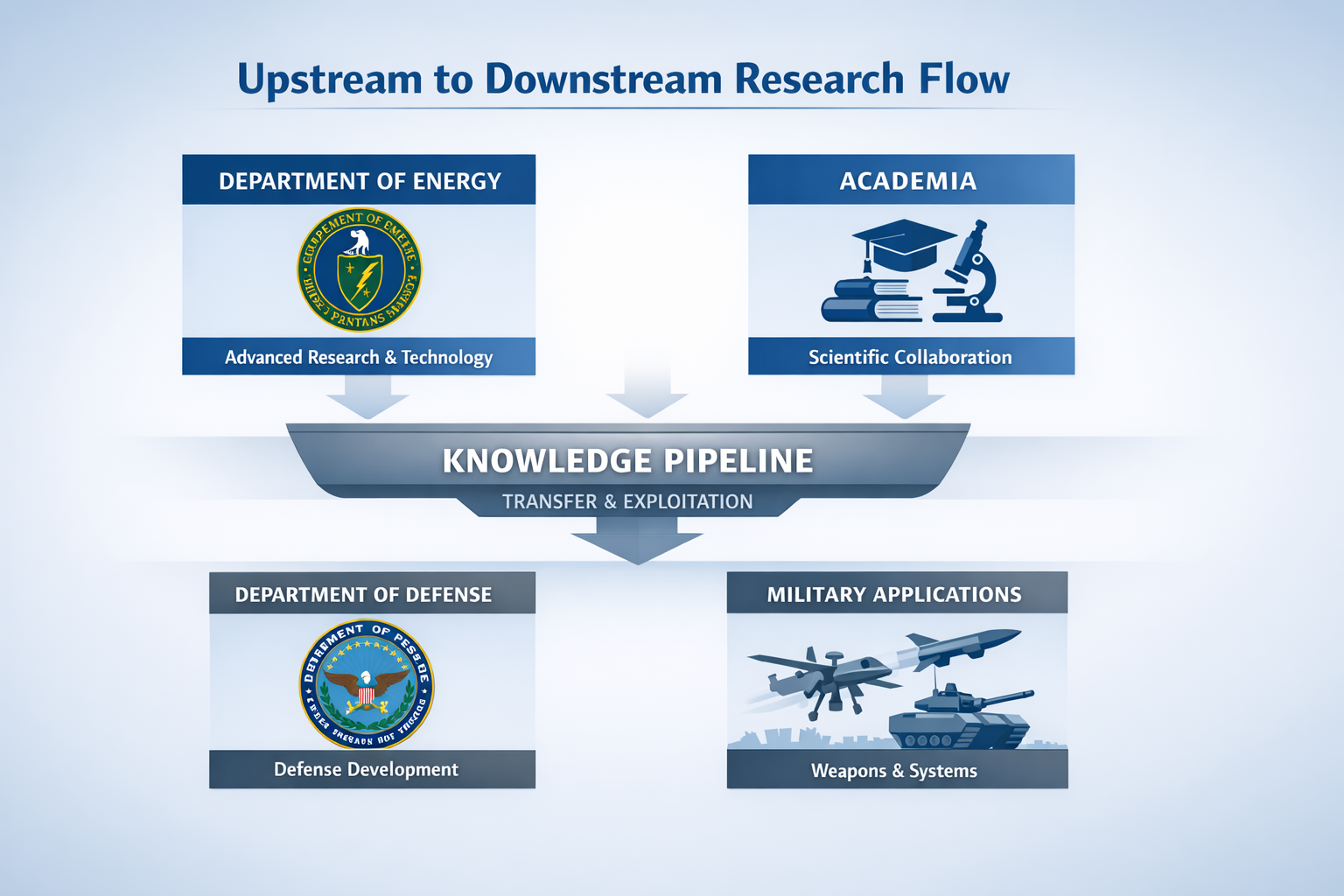
Because DOE operates upstream—at the level where future technological possibilities are defined—its compromise affects every downstream military capability that will later depend on this research.
The most serious form of infiltration is not access to battle plans or weapons specifications inside the Pentagon, but access to the institutions that determine where future weapons come from. DOE sits precisely at this upstream position. Its work in nuclear science, energy systems, advanced materials, computation, and simulation defines the technological ceiling of future military power—far more fundamentally than any single exercise plan or weapons parameter ever could.
By contrast, the Department of Defense (DOD) operates primarily downstream. It integrates, tests, procures, and deploys capabilities that are already technologically possible. While DOD faces its own risks of espionage and influence, those risks are bounded by classification systems, counterintelligence controls, and operational compartmentalization. DOE, however, shapes the very scientific foundations upon which future DOD capabilities will depend—making exploitation at this level far more consequential and far harder to reverse.
II. Academia: The Perfect Disguise
The investigation identified approximately 4,350 research papers between June 2023 and June 2025 involving DOE funding and partnerships with entities tied to communist China. More than 2,200 of these publications were coauthored with organizations embedded in communist China’s defense research and industrial base.
These included the “Seven Sons of National Defense” universities—elite institutions directly overseen by the Chinese Communist Party and the People’s Liberation Army—as well as the Chinese Academy of Engineering Physics and state-owned defense conglomerates such as China Electronics Technology Group Corporation (CETC).
These cases are not anomalies. They represent a repeatable pattern in which institutions presented as academic partners function in practice as extensions of a Party-controlled military–industrial system.
For readers unfamiliar with communist China’s structure, it is essential to understand that there is no meaningful separation between academia, industry, and the military. Research conducted in one domain is routinely transferred to military applications through formal and informal state channels.
In U.S. academia, peer review is assumed to guarantee neutrality, coauthorship signals legitimacy, and open publication is equated with safety. These assumptions collapse when academic collaboration is treated by one side as a military acquisition channel.
III. How “Open Science” Became a One-Way Pipeline
Once the integrated Party–state–military nature of communist China’s system is understood, the mechanism of exploitation becomes clear. What appears to Americans as benign “open science” does not remain open or neutral once absorbed into that system.
The core problem is not the leakage of classified information, but the unrestricted sharing of unclassified, foundational research—the most difficult, expensive, and strategically decisive stage of innovation. Inside communist China’s Party-controlled system, such research is consolidated, directed, and mobilized as a strategic resource.
This stage determines long-term military advantage. Foundational research defines not only what technologies are possible, but how quickly they can be transformed into operational systems—and who will be prepared to counter them.
The United States paid for original discovery, decades of trial-and-error, and countless failed models. Communist China obtained validated pathways, working frameworks, and immediately adaptable military knowledge.
As a result, communist China was able to leapfrog entire generations of research, positioning itself to counter U.S. systems even before they are fully deployed.
IV. Below the Threshold of War
As House Intelligence Committee Chairman Rick Crawford observed, communist China operates below the threshold of armed conflict. This is deliberate.
No shots are fired. No treaties are violated. No spies are caught.
Instead, institutions built on trust, openness, and good faith are repurposed into conduits for military advancement. This form of unrestricted warfare is conducted through bureaucratic normalcy rather than overt aggression.
This is an instance of unrestricted warfare initiated by the Chinese Communist Party, yet the United States, operating within a framework of bureaucratic normalcy, misinterpreted the adversary’s “bullets” as routine engagement and allowed them to pass—rather than recognizing them as hostile attacks and responding accordingly.
V. Why the 2023–2025 Window Matters
The surge in collaboration between 2023 and 2025 represents the concentrated effect of earlier policy choices rather than a sudden deviation.
During this period, research collaboration was prioritized over risk mitigation, national security review mechanisms lagged behind scientific output, and DOE relied heavily on institutional trust and self-policing.
At the same time, communist China had refined a patient strategy: no longer stealing technology, but waiting for it to be transferred legally. When permissive systems meet strategic patience, the result is acceleration—not cooperation.
VI. The Real Question: Has the Pipeline Been Shut Down?
Public exposure alone does not neutralize a structural threat. This question can only be answered by examining whether funding has been frozen or revoked, accountability has been enforced, and institutional safeguards have been fundamentally redesigned.
If the structure remains intact, the pipeline remains open—and the next “harmless” collaboration with communist China is already underway.
Conclusion: This Is a National Security Reckoning
This investigation should mark a turning point toward strategic clarity.
Scientific openness cannot mean strategic blindness. Collaboration cannot come at the cost of national survival.
America does not face a shortage of innovation; it faces a failure to protect the systems that produce it.
The remedy is neither panic nor isolation, but firm boundaries: enforcing strict research security, ending collaboration with communist China’s military-linked institutions, and closing the pipeline before irreversible damage is done.
Appendix: Policy Context — How Research Collaboration Became Normalized
This appendix provides historical policy context only. It makes no judgment regarding intent or motive. Its purpose is to help readers understand how the structural conditions described in this article came into being.
A. Before Obama: Cold War–Era Guardrails and Strategic Separation (Pre‑2009)
Prior to the Obama administration, U.S. policy toward strategic competitors—especially communist and authoritarian states—was shaped by Cold War–era assumptions that emphasized separation between national security research and adversarial systems.
Key characteristics of this period included:
- Clear institutional boundaries between civilian research and military competitors
- A default assumption that foundational science related to nuclear, energy, materials, and advanced computation carried inherent national security implications
- Limited and tightly controlled scientific exchanges with adversarial or military‑aligned institutions
While academic collaboration existed, it was constrained by an underlying strategic premise: upstream scientific capacity was inseparable from long‑term military power.
B. Obama Administration: Engagement and the Reframing of Science (2009–2016)
During the Obama administration, U.S. policy underwent a significant conceptual shift. Scientific collaboration began to be reframed as a stabilizing force rather than a strategic vulnerability.
This period was marked by:
- The promotion of scientific engagement and global cooperation as tools of diplomacy
- A growing emphasis on shared challenges such as climate change, energy security, and non‑proliferation
- The positioning of agencies such as the Department of Energy as platforms for international cooperation rather than strategic gatekeepers
Under this framework, collaboration in foundational research increasingly came to be viewed as non‑military by default, even when conducted with institutions operating inside authoritarian or Party‑controlled systems.
C. Interruption Without Structural Change: The Trump Years (2017–2020)
The Trump administration marked a departure in rhetoric and competitive framing, explicitly identifying communist China as a strategic competitor.
During this period:
- Export controls and technology restrictions were tightened in downstream and applied domains
- National security concerns were elevated within the Department of Defense and intelligence community
However, the underlying research architecture—particularly within academia and DOE‑linked institutions—was not comprehensively restructured. Many collaborative mechanisms were slowed, frozen, or subjected to review, but the foundational pipeline itself remained largely intact.
D. The Biden Administration: “No Decoupling” and Managed Risk (2021–2025)
Beginning in 2021, U.S. policy language shifted again. Senior administration officials repeatedly emphasized that the United States was not seeking decoupling, but rather de‑risking and the establishment of guardrails.
In practice, this approach:
- Rejected wholesale separation in favor of selective risk management
- Re‑legitimized international scientific collaboration as a default posture
- Relied heavily on institutional self‑policing, disclosure requirements, and academic norms
Within this policy environment, upstream research collaboration—particularly in energy, materials, computation, and related fields—expanded rapidly, even as concerns about military exploitation grew.
E. Structural Consequence (Not Attribution)
Taken together, these policy phases illustrate a cumulative outcome rather than a single decision point.
The conditions identified in this investigation did not arise overnight. They reflect:
- A long‑term shift in how foundational science was categorized
- The gradual erosion of upstream security assumptions
- The absence of hard red lines separating civilian research from adversarial military systems
This appendix does not assign responsibility. It clarifies how a lawful, normalized research environment emerged—one that adversarial systems were structurally positioned to exploit.
 The Light in the Shadows
Leave a comment