The Chinese Communist Party has already pushed unrestricted warfare into every layer of industry, technology, supply chains, and institutional systems. If the American people remain in a mindset of waiting for “complete investigative conclusions” before forming judgment and taking action—while failing to recognize that comprehensive decoupling from the CCP has become an unavoidable directional choice—then the United States is destined to remain perpetually one step behind.
This judgment is not based on speculation. It has been repeatedly confirmed by institutional evidence.
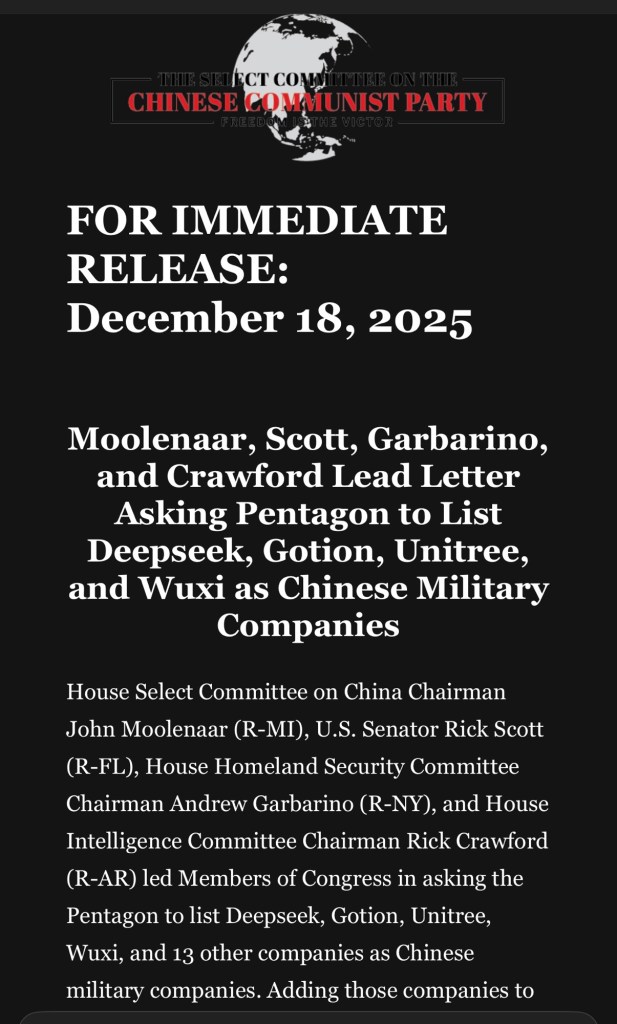
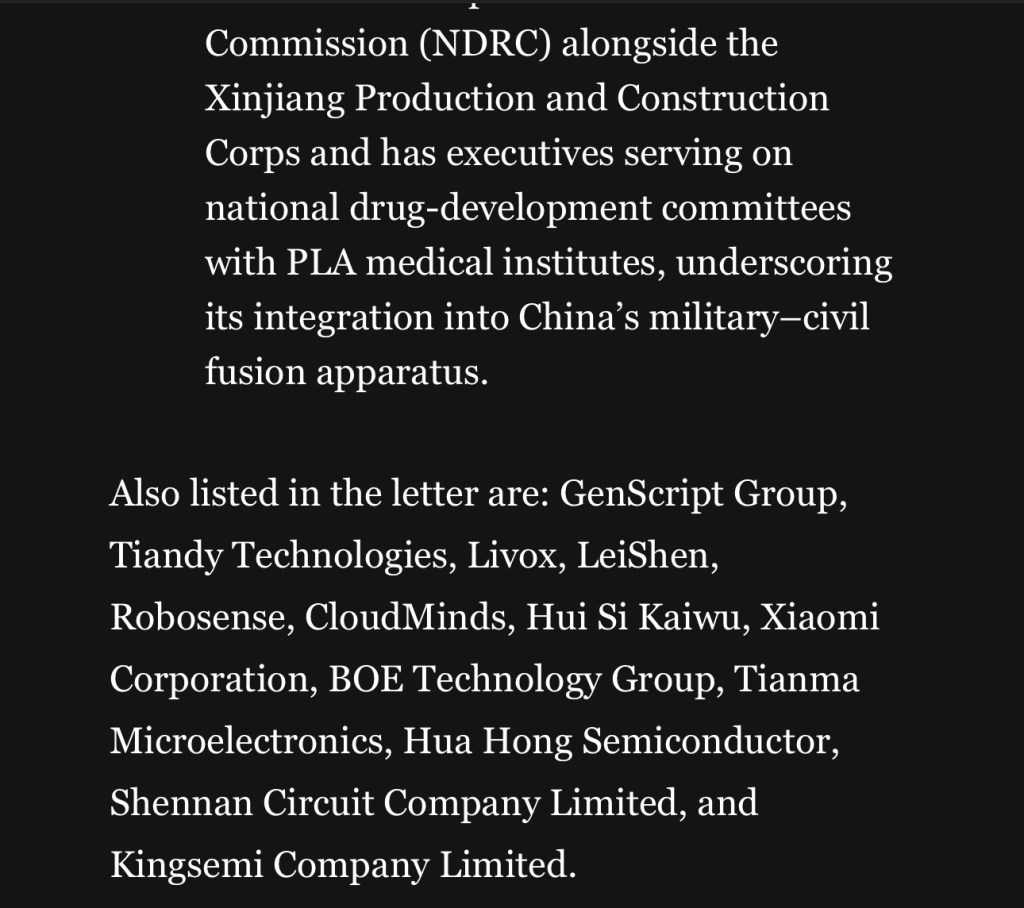
A formal letter jointly signed by the chairmen of multiple key U.S. congressional committees and submitted to the Department of Defense explicitly urges the Pentagon to designate several Chinese companies—including DeepSeek, Gotion High-Tech, Unitree Robotics, and WuXi AppTec—as Chinese military-affiliated companies.
The basis for this request is not a single allegation, but a converging body of verifiable facts, including:
— Companies that have long and actively provided technology or services to the People’s Liberation Army (PLA) and the CCP’s intelligence apparatus;
— Companies that have entered into joint ventures or deep cooperation with Chinese military-industrial groups, aerospace systems, or military–civil fusion funds;
— Corporate leadership that includes individuals drawn directly from PLA (People’s Liberation Army) or military research institutions;
— Products that have been publicly deployed in PLA training exercises and operational drills;
— Firms incorporated into state-designated “military–civil fusion demonstration zones” and national strategic industry clusters.
More importantly, this letter does not represent a new discovery, but the continuation of a judgment that has already been repeatedly validated.
The letter explicitly notes that Tencent has already been added to the Section 1260H list, and that the Department of Defense has informed Congress that Alibaba, Baidu, and BYD should likewise be designated as companies supporting the PRC’s military. Enterprises such as Huawei, long recognized internationally as extensions of the CCP’s military and intelligence system, represent some of the earliest and most illustrative examples of this same structural reality.
These companies span artificial intelligence, cloud computing, batteries, advanced materials, robotics, biotechnology, telecommunications equipment, semiconductors, and core manufacturing technologies. They differ widely in commercial form, yet display a striking uniformity in institutional character.
This continuous, cross-industry, and verifiable chain of facts points to an unavoidable institutional reality: under CCP rule, there is no such thing as a genuinely private enterprise in China. More precisely, within the CCP’s highly centralized authoritarian system, nearly all Chinese companies that possess scale or strategic value—whether willingly or not—are ultimately absorbed into structures that serve the Party’s objectives.
What we see in these designations is not that certain companies “crossed a line,” but that within this system, once an enterprise reaches sufficient scale or controls critical technology or strategic resources, whether it serves the CCP’s military, intelligence, and global expansion goals is no longer a matter of corporate choice, but an institutional inevitability.
Under such a system, “commercial neutrality” is not a principle that has been violated; it is a concept that never existed—and was never permitted to exist—in the first place.
Because the CCP is advancing a comprehensive, long-term, cross-domain form of unrestricted warfare, while the United States continues to rely on sector-by-sector, company-by-company, and case-by-case investigative mechanisms, the two sides operate on fundamentally asymmetric timelines.
While investigations proceed in one domain, the CCP often completes new deployments in others. By the time a single company is formally designated, the relevant technologies, production capacity, and dependency relationships are often already entrenched.
This is not a question of whether any particular department is working hard enough. It is the consequence of a societal mindset that insists on waiting for complete investigations before forming necessary judgments—thereby guaranteeing that action always comes after the fact. When a society becomes accustomed to using “pending investigation” as a reason to defer judgment, what it postpones is not merely action, but an honest reckoning with reality.
Rare earths provide a clear illustration of this structural time gap. As recently as 2020, the United States was not yet truly “choked” in this domain. Within just a few years, rare earths were transformed by the CCP into a strategic lever over America’s industrial and defense base.
By the time the United States mobilized a serious response, the reality on the ground had already changed. And there is no reason to assume that, as America identifies and attempts to repair these choke points one by one, the CCP will not complete new deployments in other critical areas that have yet to be fully recognized.
Precisely because the CCP has already advanced unrestricted warfare across industry, technology, supply chains, and institutional systems, total decoupling is no longer one option among many—it is the only direction that preserves American agency. This is not a question of convenience or extremism, but of whether a society still intends to retain control over its own pace and destiny.
Refusing to confront this directional necessity will not produce stability or security. It will only ensure that the United States is repeatedly forced to respond after realities have already taken shape. When dependency is deliberately constructed, exploited, and weaponized by an adversarial system, it ceases to be cooperation and becomes a sustained threat to America’s security and its freedom of decision.
A society that continues to seek safety within dependency ultimately loses not only its range of choices, but its capacity to discern reality itself. And once that capacity is eroded, even the most rigorous investigations and the most careful procedures can only take place after the adversary has already moved ahead.


 The Light in the Shadows
Leave a comment