American law was built on biblical foundations and designed for One Nation Under God. If the United States permits Sharia or any external legal system to operate alongside the Constitution, it will dissolve legal unity, abandon the weak, and forfeit the very sovereignty entrusted by God. Law is not culturally neutral; it is civilizational. And America must choose whether it remains under God — or becomes a divided legal archipelago.
——————————————————————-
In recent years, a number of Western nations have begun to allow Islamic legal structures to enter their judicial systems. The United Kingdom and Canada have already legalized portions of Islamic family law. Within the United States, several Muslim advocacy groups have likewise demanded that Sharia be permitted to operate inside Muslim communities as a parallel legal system, particularly in matters involving marriage, divorce, child custody, inheritance, and family arbitration. American courts have already encountered cases in which Muslim litigants or attorneys attempted to introduce aspects of Islamic legal reasoning, and U.S. courts have gone so far as to recognize Islamic arbitration panels—allowing them to operate privately—while stopping short of enforcing their decisions. In effect, the state has acknowledged the existence of a religious legal tribunal, but has refused to recognize its rulings.
Supporters of these developments typically invoke phrases such as “religious freedom” and “multiculturalism.” Critics warn that this constitutes an erosion of American legal sovereignty. Meanwhile, a growing chorus claims that America must “listen to the needs of religious communities” in order to make room for legal pluralism.
However, what is at stake is not merely a cultural disagreement nor merely a religious debate. It concerns the integrity of:
- constitutional sovereignty
- judicial unity
- citizenship and legal personhood
- the protection of the weak
- and the foundations of civilization
If the United States allows any external legal system to operate alongside American law, the nation will no longer possess a unified system of justice, a unified citizenry under one law, nor a constitutional order capable of governing the nation. The immediate and visible damage would be the weakening of America’s ability to adjudicate complex family and commercial disputes. The deeper and less visible damage would be civilizational: the country would drift away from God, away from truth, and toward decline.
America’s legal system is not grounded in cultural relativism nor in secular proceduralism. It is grounded in divine truth. The law of the United States was built upon biblical foundations and upon the truth revealed by the Triune God. The Constitution was not a compromise between religions; it was written for a people who understood themselves to be One Nation Under God. Therefore American law is not doctrinal rigidity nor religious accommodation, but a legal order in which mercy and justice coexist under truth.
Such a legal order was established to honor God, and therefore it cannot allow any competing legal system to take root, nor allow an external legal code to become a parallel authority. If America were to allow such systems to operate, the result would be predictable:
the fragmentation of legal personhood → the division of citizenship → the erosion of sovereignty → and the dismantling of civilization
America is indeed an immigrant nation. That is not in dispute. But when immigrants bring external legal traditions into the United States, the question the nation must answer is not whether their culture ought to be respected, but whether their legal systems ought to be allowed to govern.
Recent American cases involving Sharia provide a sobering answer.
I. Attempts to Introduce Islamic Law Into Family and Property Disputes
1. Prenuptial Property and Islamic Marriage Contracts
In some Muslim marriages, the bride itemizes her property or dowry within a religious marriage contract. In Islamic tradition this serves a religious function; within American legal structure it forms a prenuptial property agreement.
In one such case, a Muslim wife listed her assets in detail and delivered them into the marriage. The terms were clear, signed by both parties, and witnessed. Upon divorce, the return of property was contested. The court ultimately ruled that the property must be returned—a correct outcome. Yet a troubling development occurred during litigation: some attorneys and observers attempted to analyze the dispute through an Islamic legal lens, implying that Sharia should inform property distribution. If accepted, such reasoning would have allowed an external legal system to enter American judicial space.
The proper judicial path is straightforward:
The matter must be adjudicated entirely under American contract law and prenuptial property rules.
A signed contract with clear terms is enforceable under U.S. law. No reference to Sharia is required or permissible.
2. Mahr Contracts and Forced Religious Obligations
In another case, a Muslim husband promised to pay his wife a religious mahr—financial compensation owed upon divorce or death. When the couple divorced, the wife demanded enforcement. Opponents argued that the agreement was signed under religious and familial pressure and therefore involuntary. The court found itself trapped inside the question:
Do religious obligations possess civil enforceability?
Once again, the American legal answer is clear:
If an agreement was not entered voluntarily, it is void as a contract, and the divorce must be adjudicated entirely under U.S. family law.
American family law already possesses the tools necessary to ensure justice through:
- financial contribution analysis
- child custody and care
- the best interests of the child
- economic capacity review
- marital fault and responsibility
- the protection of the weak
This path protects the vulnerable, protects religious liberty, and protects judicial sovereignty. No religious legal code is needed.
3. Attempts to Introduce Religious Standards into Custody Decisions
In a third category of cases, one parent demanded that custody be determined based on whether the other parent would raise the child according to Islamic norms. If accepted, this would transform the court’s duty from:
protecting the child → to evaluating religious fidelity
This is a fundamental distortion. American family law stands upon a single civilizational principle:
the best interest of the child
This requires the court to consider a complex set of variables such as:
- emotional attachment
- stability
- education and healthcare
- psychological and physical safety
- parental responsibility
Religious legal systems are not designed to bear this complexity. They are fixed doctrinal systems; American family law is investigative and reality-based. Therefore courts must not allow religious law to enter custody adjudication.
II. Attempts to Introduce Islamic Arbitration Into Commercial Disputes
Many assume that religious law only affects families. In reality, commercial infiltration is more dangerous because it attacks the structure of the legal system itself. Some Muslim parties have submitted commercial disputes—regarding debt, profit distribution, and contractual obligations—to Sharia arbitration panels on the grounds of “mutual consent.” This appears at first glance to be an exercise of contractual freedom. In fact, it undermines freedom.
American arbitration is not a substitute for judicial authority but a tool subordinate to it. It has limits:
- arbitration cannot harm the weak
- cannot contravene public policy
- cannot replace the courts
- cannot form a parallel legal system
- and cannot use religious law to replace American law
Islamic arbitration, however, is grounded in religious obligation, communal pressure, and theological authority. It is not neutral arbitration; it is quasi-judicial religious governance.
The United States has already compromised by allowing Islamic arbitration to exist while refusing to enforce its decisions. Many believe this compromise solves the problem. It does not. It merely postpones the pain.
America must not accept the current arrangement in which Islamic legal panels may exist privately but lack enforcement. Such a compromise fails to protect America’s long-term interests. It merely creates a short-term inconvenience for litigants who cannot enforce rulings, while the deeper structural harm remains hidden. Over time, both the individual and the nation will feel the pain. The United Kingdom provides a twenty-year demonstration.
III. The United Kingdom: A Twenty-Year Path of Long-Term Pain
The United Kingdom is not an exception; it is a preview.
Phase One: Recognition of Religious Arbitration (No Pain)
The state compromised under the banner of religious freedom. Society mistook this for progress.
Phase Two: Entry into Family and Inheritance (Light Pain)
The weak delayed entry into state courts; rights began to erode.
Phase Three: State Retreat (Hidden Pain)
Police and courts avoided religious communities. The state withdrew.
Phase Four: Emergence of Parallel Judicial Systems (Heavy Pain)
Women and children became subject to religious tribunals rather than national law.
Phase Five: State Regret (Late Pain)
Britain acknowledged that judicial sovereignty had been ceded. It attempted to reverse course, but the damage was institutional.
Britain proved a critical truth:
The danger lies not in enforcement, but in existence.
IV. America Stands at the Beginning of Britain’s Curve
The United States today stands where Britain stood twenty years ago. If America does not correct previous compromises, and refuses to end further compromises, it will undergo the same progression:
- identity-based legal fragmentation
- the dissolution of legal personhood
- the abandonment of the weak
- the replacement of civil courts with religious authority
- the shrinkage of constitutional sovereignty
- the collapse of legal unity
- the fragmentation of civilization
America has not yet felt the pain, not because there is no injury, but because the injury is in a civilizational latency period.
V. Conclusion: America Must Defend Its Legal Sovereignty
The laws of a nation define what that nation is. The foundation of a nation’s legal order determines its destiny. America became a refuge of liberty not because it was clever nor because it was kind, but because it recognized a higher truth at its founding:
Truth is revealed by God, and law must conform to that truth.
Therefore American law is not a religious doctrine, but a legal system in which mercy and justice coexist. It does not serve the powerful; it protects the weak. It does not follow culture; it follows truth.
This is why America cannot allow any external legal system to enter its judicial sphere. Whether clothed in the language of religious freedom, multiculturalism, or anti-discrimination, the substance remains the same. Scripture has long taught that the devil never appears under his own name; he always cloaks himself in the garments of good intentions to dismantle civilization from within.
Today, Americans witness corruption, legal cowardice, political decay, and the infiltration of hostile foreign powers—most of all the Chinese Communist Party. Men driven by private desire seek law outside truth, wisdom outside the Constitution, and order outside God. The result is always the same: when men depart from God, nations begin to dismantle themselves.
If the United States allows religious law, identity law, or cultural law to enter its judicial order, it will cease to be a unified legal nation and will become a tribal legal archipelago. The weak will have no recourse, women no justice, children no refuge, and the devil will rule from the cracks of the constitutional order.
America must awaken. America must return. America must end judicial compromise and correct past concessions. America must once again acknowledge the truth recognized by the Founding Fathers: the law belongs to the Constitution, and sovereignty belongs to God.
Corruption today does not lie in the Constitution but in the human heart. If the heart continues to depart from truth, America will continue to depart from God. And when America departs from God, it will lose everything—law, liberty, and happiness.
Therefore the United States must defend its legal sovereignty. It must reject external legal systems. It must return to the Constitution and to the order established by God—not for the sake of victory nor for the sake of power, but for the sake of the weak, the child, the family, justice, liberty, truth, and the God who gave both divine law and the Constitution. In short, for the glory of God.
Evil does not forgive weakness. Truth does not forgive compromise. And the devil never ceases his assault simply because men pretend to be neutral. Now is the time for America to stand.
May America once again be — One Nation Under God.
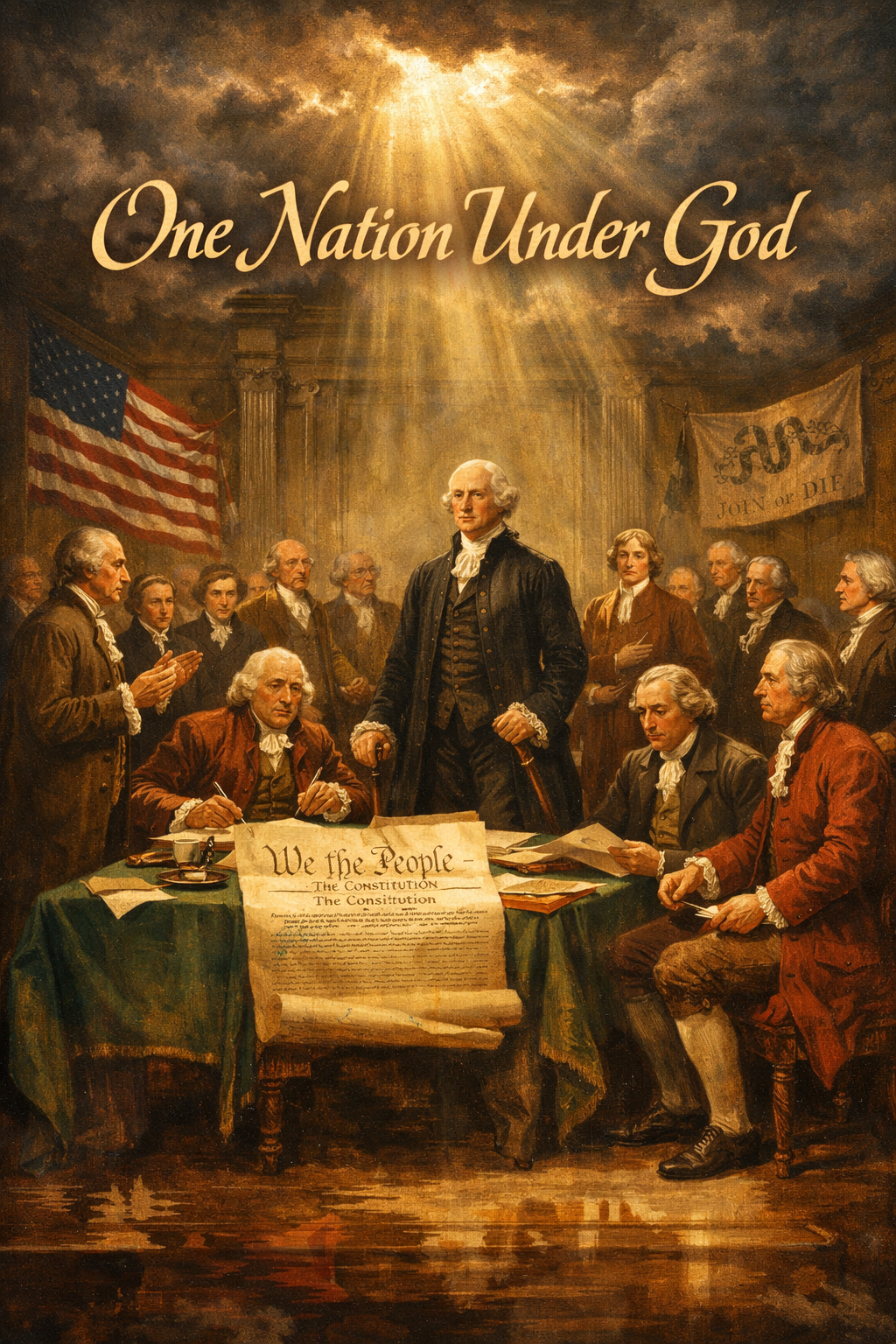
 The Light in the Shadows
Leave a comment