Summary:
This reflection on the Frankfurt Inscription—a third-century silver amulet engraved with Christian prayers—reveals the profound truth that faith precedes power. Long before Constantine’s conversion, the Gospel had already taken root in ordinary hearts north of the Alps. The discovery affirms that God’s Kingdom is built not by human authority but by transformed hearts; that truth and worship transcend culture and time; and that the light of Christ, once kindled, has never been extinguished.
——————————————————————-
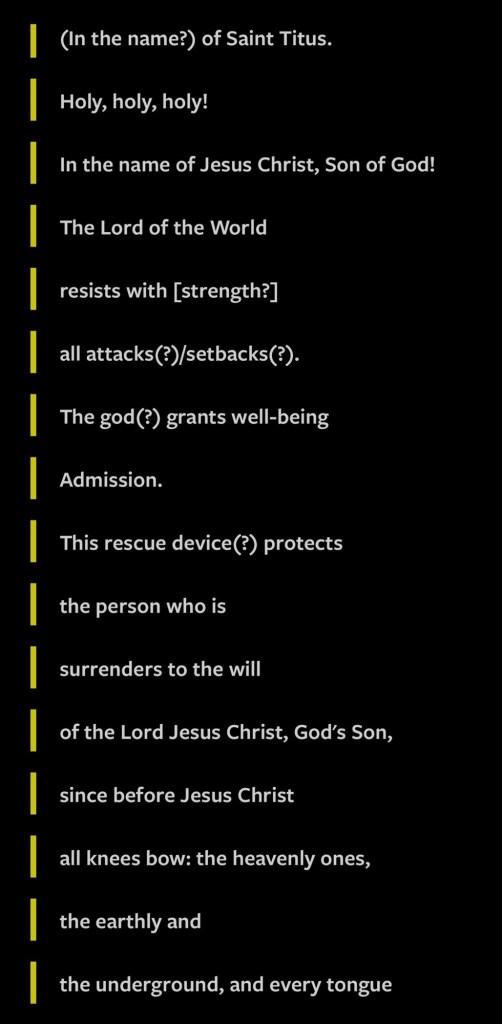
I recently read an archaeological report about a remarkable discovery in Frankfurt, Germany.Archaeologists unearthed the remains of a Roman-era man, and beneath his jaw they found a small silver amulet. Through advanced scanning and 3D reconstruction, researchers were able to read eighteen lines of Latin inscription engraved on the fragile silver sheet.
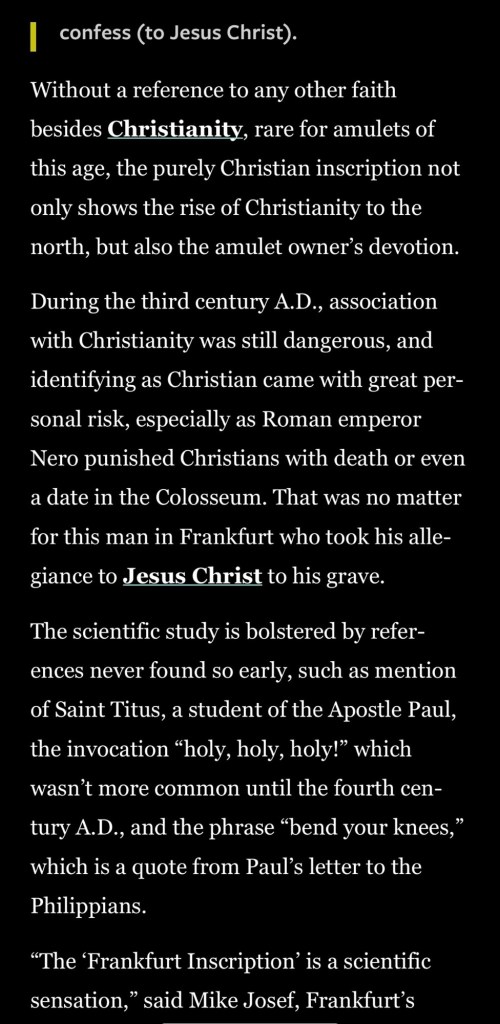
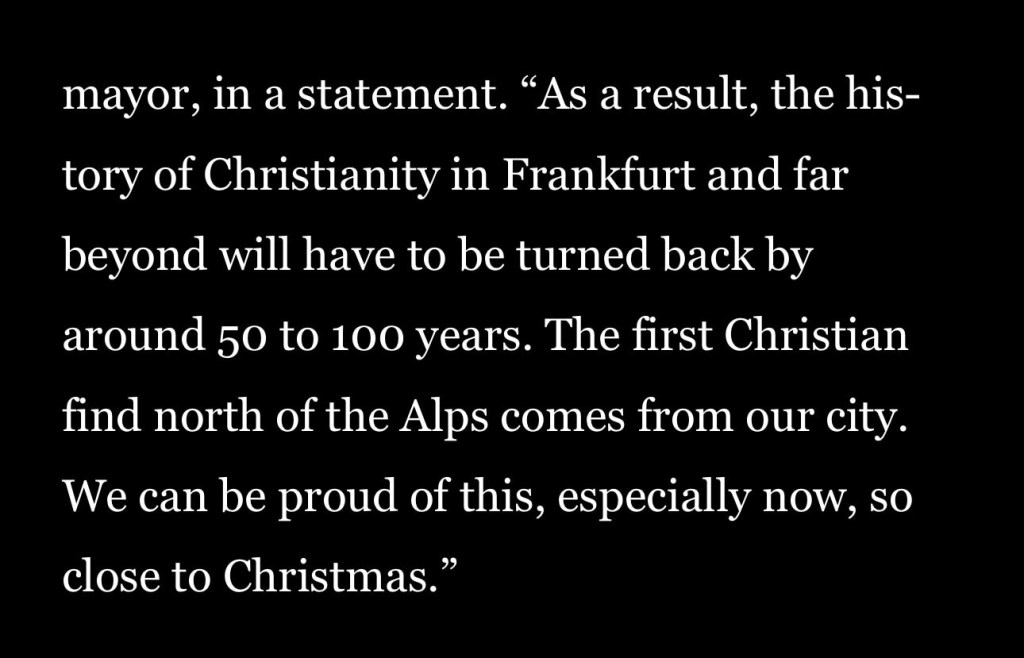
The amulet was dated to the third century (around AD 230–270). Its text consists entirely of Christian prayers and confessions of faith, including phrases such as “In the name of Jesus Christ, the Son of God,” “Holy, holy, holy,” and a line echoing Paul’s words that “every knee shall bow.” Scholars have called it the Frankfurt Inscription, now regarded as the earliest known evidence of Christian faith north of the Alps—approximately fifty to one hundred years earlier than previously believed.
I. The Spiritual Significance: The Seed of Truth Had Already Taken Root
The meaning of this discovery goes far beyond simply “pushing the timeline back by a century.” It reveals a spiritual reality: the Gospel spreads not through political approval, but through the power of faith.
In the third century, to believe in Christ still meant rejection, imprisonment, and even death under Roman rule. Yet this man chose to be buried with a silver piece that symbolized his faith. That thin sheet of silver was, in fact, the seal of his heart—a silent declaration that his life belonged to Christ.
This reminds us: the Kingdom of God is not built by human hands, but established within the human heart. Before the Roman system ever recognized Him, the Gospel had already entered ordinary lives.
“The kingdom of God is not coming in ways that can be observed… For behold, the kingdom of God is in the midst of you.” (Luke 17:20–21, ESV)
II. The Historical Significance: Faith Beyond Power and Borders
For generations, historians believed that Christianity spread widely in Europe only after Emperor Constantine’s conversion in the early fourth century. Yet this discovery proves that the Gospel had already been quietly taking root in people’s daily lives much earlier.
It did not begin from an emperor’s throne but from the hearts of ordinary believers. It was not a top-down religious decree, but a bottom-up awakening of the soul. It was not a political movement, but a work of salvation and rebirth.
It reveals the enduring strength and breadth of the Christian faith—even without official recognition, it took root in the cultural and geographic margins. For this faith itself is truth, and the Triune God is the very essence and source of Truth. True truth inevitably reaches the human heart and spreads throughout the world.
“Not by might, nor by power, but by My Spirit, says the Lord of hosts.” (Zechariah 4:6, ESV)
This reminds us that even today, what truly transforms society is not external systems, but hearts reborn by Truth itself.
III. The Cultural Significance: The Living Language of Early Faith
The amulet’s inscription included early liturgical language such as “Holy, holy, holy,” along with phrases drawn from Paul’s letters.
This reveals several profound facts:
1.By the third century, believers were already familiar with the faith expressions of the apostolic age.
2.The truth of Scripture had already crossed barriers of language, culture, and geography.
3.Early Christian communities preserved both faith and worship even amid persecution.
4.True worship, therefore, is not institutional—it is the heart’s sincere response to God.
5.The silver amulet buried beneath the earth is not merely an archaeological artifact; it is the echo of worship from two thousand years ago.
“Holy, holy, holy is the Lord of hosts; the whole earth is full of His glory!”(Isaiah 6:3, ESV)
“At the name of Jesus every knee should bow, in heaven and on earth and under the earth.”(Philippians 2:10, ESV)
IV. The Spiritual Insight: The Light of Faith Has Never Been Extinguished
That small silver amulet is like a seed buried in the earth for nearly two millennia. When people thought it had long been forgotten, God allowed it to be revealed once again—a living testimony to the world that the light of Christ has never been overcome by darkness.
“The light shines in the darkness, and the darkness has not overcome it.” (John 1:5,ESV)
It tells us: truth spreads not by might nor by power, but by the Spirit of God. The body of a believer can be buried, but genuine faith can never be buried. The physical life of that ancient man is gone, yet his faith and devotion still speak today.
V. A Reflection for Every Generation
May every generation be like that ancient believer—wearing the amulet of faith not around the neck, but within the heart, where God alone can see.
When the world once again trembles in confusion and darkness seems to prevail, may we still hold fast to the Light that never fades—to the same Lord, the same Redeemer, Jesus Christ, who is the same yesterday and today and forever. (Hebrews 13:8, ESV)
True faith needs no historical proof; it is itself a living testimony, quietly shining in every heart awakened by God.
 The Light in the Shadows
Leave a comment