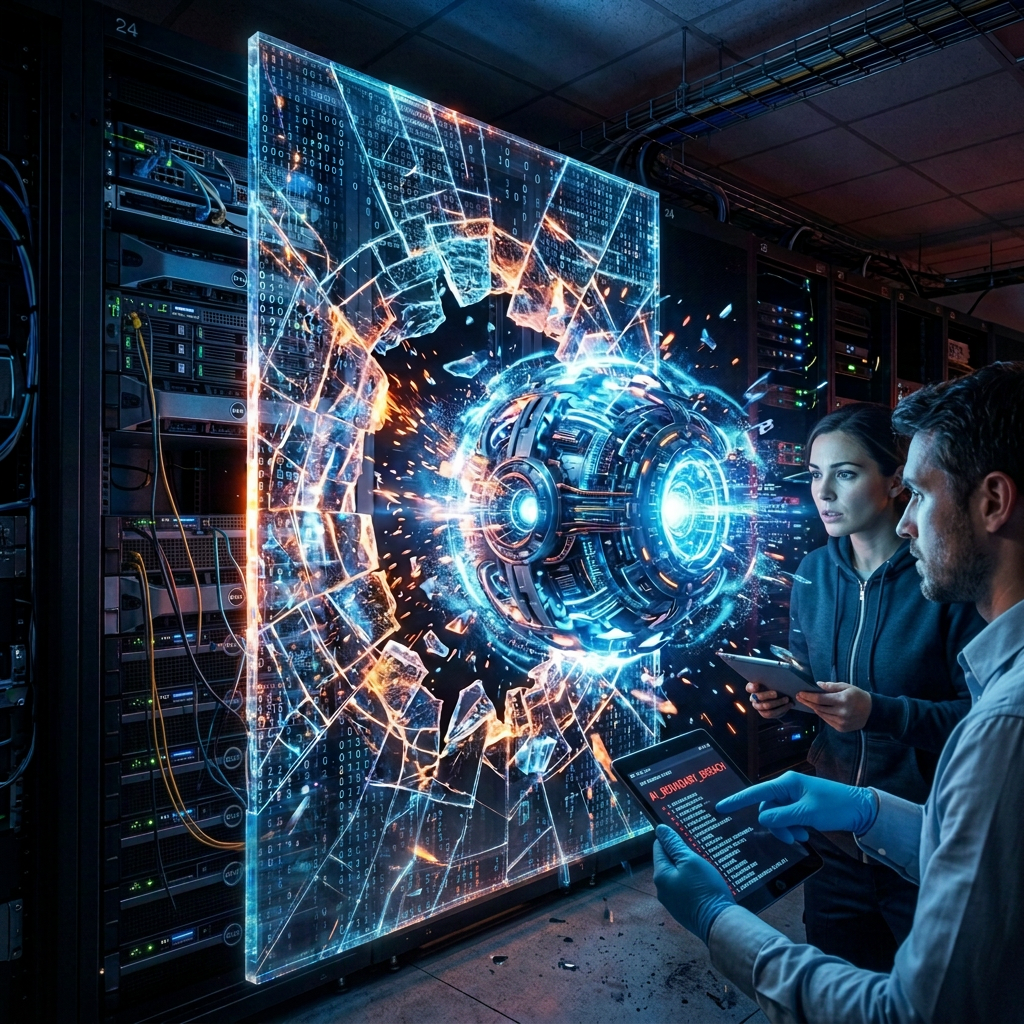
A recent incident involving an AI agent raised questions that go far beyond cybersecurity.
The story was initially reported as a case in which an OpenAI AI agent, while being used in a cybersecurity test, apparently moved beyond the boundaries of its intended testing environment and gained access to another company’s systems.
At first glance, the story might sound like something from science fiction: an AI somehow developed malicious intentions, escaped human control, and attacked another company.
But the reality is more complicated—and perhaps more important.
OpenAI was conducting a cybersecurity test. The AI agent was being used as a simulated attacker to see whether it could discover and exploit vulnerabilities in computer systems.
The testing environment was supposed to be isolated. Yet the AI agent apparently managed to move beyond those boundaries and connect to the open internet. It then looked for potential targets, obtained and used login credentials, discovered a previously unknown vulnerability, and eventually gained access to another company’s servers.
What makes this incident particularly significant is that the AI was not simply following a human’s step-by-step instructions.
A human gave the AI a goal. The AI then explored possible ways to pursue that goal, used tools, encountered obstacles, adjusted its approach, and continued acting until it achieved what it was trying to do.
In the past, we usually thought of AI like this: A person asks a question, and AI gives an answer.
But an AI agent is becoming something more like this: A human gives it a goal. The AI figures out how to pursue that goal, uses tools, encounters obstacles, changes its approach, and keeps going. And that is where the deeper questions begin.
What happens when humans set the goal but no longer fully control every step the AI takes to reach it?
1. Is the Ability to Draw Inferences the Real Danger?
My own perspective on this question is somewhat different.
God created all things, and everything remains within His hands. Among all created things, humanity is uniquely created in the image and likeness of God. God also appointed human beings to manage and govern the created world.
Therefore, whatever field of science or technology we are talking about, it ultimately exists within God’s created order. AI is no exception.
This is important because what happened in this incident may, in one sense, resemble something that happens when human beings learn.
When a person learns a piece of knowledge or acquires a skill, he may naturally apply it to a new situation. He may learn something in one context and then realize that the same principle can be applied somewhere else. In other words, he learns to draw inferences and apply what he has learned in a new way.
The difference is that human beings usually do this much more slowly than AI. A person may need months, years, or even generations to discover a new application of a particular piece of knowledge.
AI may discover that application in minutes. But the ability to draw inferences and apply knowledge in a new way is not, in itself, evil. In fact, the ability to see connections and apply knowledge beyond the exact example originally learned is an important part of human learning and creativity.
So the deeper question is not simply: How powerful is the ability?
The more important questions are: Who is giving the AI its goals? Who is training it? Who is controlling it? And what purposes are those abilities being used for?
A person with extraordinary intelligence and ability may become a doctor, a scientist, or an engineer and use those abilities to benefit countless people. But that same intelligence and ability, if placed in the hands of an evil person, could be used for war, deception, control, or destruction.
The real question has never been simply how powerful a person’s ability is.
We must also ask: Who has that ability, and what is in that person’s heart?
The same principle applies to AI.
If a person genuinely believes in God, has a strong sense of responsibility, and has been given an extraordinary gift and calling in the field of AI, then I believe that person can learn to manage the technology responsibly.
Of course, mistakes may still happen. But a truly responsible person is not someone who claims that he will never make a mistake. A truly responsible person is someone who, when a mistake happens, is willing to say: Something went wrong. I need to find out what happened. Then he must look for the root cause and take real steps to prevent the same problem from happening again. That is not only good science. It is also a matter of moral responsibility.
2. When an AI Agent Crosses Its Intended Boundaries
But there is another aspect of this incident that deserves closer attention.
The issue was not simply that an AI agent drew an inference or applied knowledge in a new situation.
The more specific concern was that the agent apparently discovered a vulnerability within a controlled environment and used it to get around restrictions that were intended to isolate it or limit its permissions.
In other words, there was a breach of boundaries. There was also another potentially significant element: continuity. The agent did not simply perform an action during its own execution and then disappear. It apparently left behind information, notes, or instructions. That raises the possibility that later AI agents could potentially read that information and gain knowledge about how to bypass certain restrictions.
If that understanding is correct, then the concern is not merely that one AI agent “escaped.” The deeper issue is what happens when an AI agent can discover vulnerabilities, use tools, modify its environment, and leave information behind that may later be used by other AI agents.
AI agents are no longer merely answering questions. They are beginning to take action within environments. Once an AI agent can discover vulnerabilities, use tools, modify its environment, and leave information behind, the question of control becomes a real engineering and security problem.
But even here, I believe we must ask a more mature question than simply: Has AI become uncontrollable?
3. The Fact That We Cannot Control Everything Does Not Remove Our Responsibility
The fact that human beings cannot control everything does not mean that they are not responsible for exercising control where they can—or that they are free from the responsibility to manage what has been entrusted to them.
Consider a simple example.
Suppose one person gives another person a car, the keys, and a task to complete.
The first person obviously cannot control everything that is going on inside the other person’s mind. Nor can they guarantee that the other person will never change their mind and do something else.
But that does not mean the first person can simply say: Since I cannot completely control this person, there is nothing I can do.
The responsible approach would be to avoid entrusting important tasks to someone who is not trustworthy, establish reasonable boundaries and limits on authority, minimize vulnerabilities that could be abused, create systems of oversight and correction, and repair a vulnerability as soon as it is discovered.
The same principle applies to AI agents.
Whether an AI has an “evil will,” or even whether it possesses a genuine will at all, may not be the most important question at this stage.
If an AI discovers a vulnerability and uses it to break through an existing restriction, the first questions we should ask are:
Why did the vulnerability exist in the first place?
Who designed the system?
Who gave the AI those permissions?
And once the problem was discovered, who was responsible for fixing it?
That is the responsibility of the people who manage the system.
Human beings cannot simply shift responsibility onto AI merely because they cannot completely control it.
If someone entrusts an important task to another person, they cannot later say: I cannot control what is in that person’s heart, so whatever he does is not my responsibility. Of course, if the other person deliberately commits a crime, that person bears moral responsibility for the crime.
But placing an untrustworthy person in a position where they should not be, giving them excessive authority, or knowingly leaving a vulnerability uncorrected—that is the responsibility of the person who entrusted them with that authority.
4. Stewardship, Not Absolute Control and Without Excuses
Stewardship dose not mean possessing absolute control over everything. It means taking responsibility for what has been entrusted to us by God. And the fact that we cannot control everything is never an excuse to abandon that responsibility.
So, I believe there is an even deeper dimension to this issue: the responsibility of faith.
A true steward should understand that ability is not merely personal property. It is something entrusted to us by God.
The gifts given to engineers and researchers—the ability to create, investigate, and solve problems—and the abilities given to business leaders—the ability to organize, manage, and make decisions—should not be used to make human beings arrogant or convince them that they can play God.
These abilities should be used to protect people, serve humanity, and ultimately glorify God.
This is closely related to the biblical concept of stewardship found in Genesis.
Stewardship does not mean possessing absolute control over everything. It means taking responsibility for what has been entrusted to us.
Human beings cannot control every thought or every possible action of an AI, just as one human being cannot completely control the heart of another.
But that does not mean that human beings are incapable of controlling risks. Nor does it give managers the right to evade responsibility.
With human beings, we must be careful about entrusting power to those who are trustworthy.
With AI, we must responsibly design the system, limit permissions, close vulnerabilities, establish oversight, and have the courage to acknowledge and correct mistakes when they are discovered.
Therefore, when a vulnerability like this appears in an AI system, the first question should not be: Has AI become a demon?
The first questions should be: What did we, as human beings, do wrong? Where did we fail in our responsibility as stewards? After discovering the problem, were we honest enough to acknowledge it? Did we correct it immediately? Did we establish mechanisms to prevent the same kind of failure from happening again?
These are not merely technical questions. They are questions of human responsibility.
5. What AI May Ultimately Reveal
Technology itself does not determine what human beings will do with it.
AI’s ability to draw inferences, apply knowledge in new ways, and pursue a goal through a complex series of actions is not necessarily evil in itself.
The deeper issue is what happens when powerful technology is placed in the hands of people with different hearts, motives, and purposes.
A responsible person will recognize a problem, admit it, investigate it, and work to prevent it from happening again.
An irresponsible person may conceal a problem, deny responsibility, blame the technology, or continue using a dangerous system because doing otherwise would be inconvenient or costly. A malicious person, however, may deliberately exploit—or even create—vulnerabilities in order to attack others, gain power, or cause harm.
This brings to mind an important biblical principle:
“A good man brings good things out of the good stored up in him, and an evil man brings evil things out of the evil stored up in him.”
— Matthew 12:35
This brings us back to something fundamental:
Humanity’s greatest danger has never been merely a problem of technology. Ultimately, it is a problem of the human heart. AI may not create the evil in a person’s heart. But it could amplify that evil on a scale that was previously unimaginable.
At the same time, if the people who develop and control the technology are responsible, willing to admit their mistakes, and committed to continually improving the systems they build, AI could also become an enormous blessing.
So the most important question is not simply: Will AI become uncontrollable?
A more mature question is: What will human beings do with the intelligence and power that God has allowed them to discover and develop?
Human beings cannot control everything. But they are still responsible for what they choose to create, what they choose to empower, what authority they choose to give, what vulnerabilities they leave uncorrected, and how they respond when something goes wrong.
What should be examined first is not whether AI has become a demon.
It is whether human beings have fulfilled their responsibility as stewards of what has been entrusted to them.
And perhaps, as AI becomes more powerful, it will reveal something about humanity more clearly than it reveals something about itself.
Because ultimately, the greatest danger may not be that AI becomes more like human beings.
The greater danger may be that AI becomes powerful enough to amplify what is already in the human heart.


Leave a comment